

As Egyptians Ignore Curfew, there is talk of Obama, U.S. Brotherhood Conspiracy
- By ROD NORDLAND - August 25, 2013 - The New York Times
CAIRO — The sounds made lately by curfew violators here are mostly not shouts or gunshots, but the clacking of dice on wooden backgammon boards, the clicking of dominoes on cafe tables crowded with hookahs and grumbling fueled by years of upheaval.
When the conversation turns to politics, the predominant topic is a surprise to American ears: the conspiracy between the United States and the Muslim Brotherhood to destroy Egypt.
However crackpot that view may sound, it is widespread among supporters of the military, which ousted the Muslim Brotherhood’s elected president, Mohamed Morsi, last month.
For journalists who ventured out Saturday night in violation of the curfew, the biggest danger was not from police officers and soldiers at checkpoints, but from angry men with a chip on their shoulders and a grudge against Al Jazeera, the Western press and America.
The “people’s committees,” which sprung up in Egyptian neighborhoods as a counterweight to the Muslim Brotherhood, in theory were disbanded last week. But that did not stop self-appointed guardians in the Zaki Street market of the Maadi neighborhood from repeatedly demanding identity documents, letters of permission and, especially, proof of not being affiliated with Al Jazeera, the pan-Arab news network, which is reviled because it is owned by Qatar, a strong supporter of the Muslim Brotherhood.
As patrons of the Red Apple Cafe ignored the new 9 p.m. curfew, the presence of an American elicited bountiful conspiracy theories, all of them involving America’s plan to destroy Egypt through its paid Brotherhood confederates. Even innocuous questions about the curfew, which on Saturday was shortened two hours, became ideologically fraught. “What are you doing, why are you asking about curfew?” yelled one man. “It is something internal.” A group of other men surrounding an interpreter, their faces only inches from his, introduced themselves by saying, “We are not thugs,” before proceeding to threaten and berate their interlocutors.
Egyptians have always shrugged off curfews. Cairo’s night life continues pretty much as normal in places like Maadi and especially in poor and working-class areas, where street life provides some relief to people who live in hot apartments.
On Zaki Street, the cafes were full of smokers of shisha, the flavored tobacco burned in water pipes, and of backgammon players. Outside, the driver of a horse-drawn cart full of canisters of cooking gas clanged his cans to announce his presence, and Farouq, a middle-aged man making deliveries to supermarkets with a motorcycle-drawn cart, stopped to talk.
“Americans are with the Muslim Brotherhood,” Farouq stated in a tone suggesting that it was common knowledge. “O.K., you did something good when you killed Osama bin Laden, but now you are with Al Qaeda. You support the terrorists.”
A strong anti-American undercurrent has always existed in Egypt, but such views are more normally associated with radicals and Islamists, and in reaction to American support for Israel.
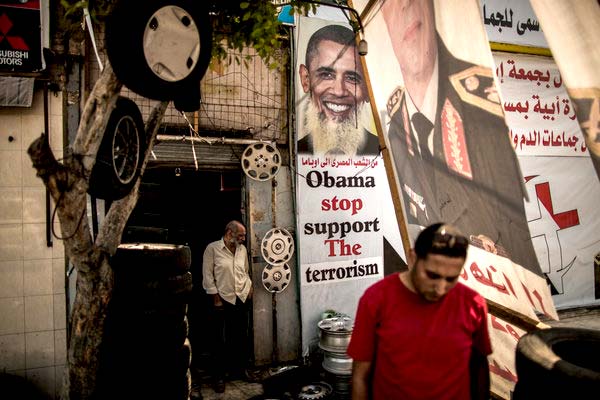
But now anti-American sentiment is being stoked by an outpouring of dubious pronouncements from both state and private news media. Anti-Americanism has even been given the ultimate imprimatur of state tolerance: billboards. One next door to the Ministry of Foreign Affairs, for instance, shows President Obama with a beard like those worn by the Brotherhood, alongside a more flattering picture of the clean-shaven military leader, Gen. Abdul-Fattah el-Sisi.
Youm 7, which claims to be the Arab world’s biggest news Web site, recently invited reader reactions to a forum titled “America and Al Qaeda: One Hand Against Egypt.” Hundreds responded.
“Maybe it’s insane,” allowed Khaled Salah, Youm 7’s editor in chief, “but we are in a time when crazy things are happening.” Egypt’s leaders have carefully avoided anti-American rhetoric, Mr. Salah said. “After a time, rationality will return.”
The origin of the idea of a terrorist-friendly America is opaque. Many cite money given to the Brotherhood, but what they are referring to is the $1.5 billion in American aid to the government of Egypt, which flowed to Mr. Morsi’s government as it did to the government before it, and as it continues to do since the military takeover. Most of that, $1.2 billion, goes to the Egyptian military, and none of it goes to the Brotherhood.
In fact, Mr. Obama has taken a great deal of criticism for not cutting off aid to Egypt after the military crackdown killed more than 1,100 people, most of them Brotherhood protesters.
“We’ve been blamed by supporters of Morsi; we’ve been blamed by the other side as if we are supporters of Morsi,” Mr. Obama said on Aug. 15 when he announced the only real American sanction so far in response to the violence, the cancellation of a joint military exercise. “That kind of approach will do nothing to help Egyptians achieve the future that they deserve.”
Many Egyptians refer to YouTube clips played repeatedly by the pro-military news media, quoting Representative Louie Gohmert, Republican of Texas, who recently equated giving $1.5 billion in aid to the Morsi government with support for terrorists.
Back in the Maadi neighborhood, supporters of the military offered similar theories. “The American and Muslim Brotherhood project is to separate Egypt into different parts,” shouted Yahyeh, a builder, his face contorted with hatred. Ahmed, an engineer who said he had worked 22 years for Xerox in Cairo, was only slightly less hostile. “Egyptians have always liked America, but now they don’t understand how it has changed,” he said.
But a few contrary voices could be heard on Saturday night.
“Show me any evidence that America supports the Brotherhood,” said Ahmed Abdullah Wahed, a driver, after listening to others in the crowd. “General Sisi was even trained in America. Where is the evidence?”
Another man had some advice for how his questioners should handle curfew checkpoints. “Whatever you do, don’t tell them you’re American journalists,” he said. “Just say you’re tourists.”
Voice of Russia: News of chemical weapons attack in Syria published one day before massacre
Terrorists in Syria used chemical weapons to attack Syrias people, then blamed the Syrian government for the attack on August 21, 2013
voiceofrussia.com
June 23, 2013
The Islamic politics and cultural website Islamic Invitation Turkey claims that several videos were uploaded one day before the reports on chemical weapons use near Damascus in Syria. This evidence shows that the terrorists massacred people then recorded the scenes to deceive the world, but they gave themselves away. Terrorists in Syria uploaded the video of their crimes in East Ghouta, Damascus on August 20, 2013 and then blamed the Syrian government for the attack early on August 21, 2013, says the IIT website.
This evidence supposedly shows the massacre by terrorists in Syria and their struggle to convince the public that the Syrian regime is behind the massacre. You will see that the terrorists uploaded the videos before the massacre and their so-called allegation of the time when the chemical weapons attack by the Syrian Army occurred.
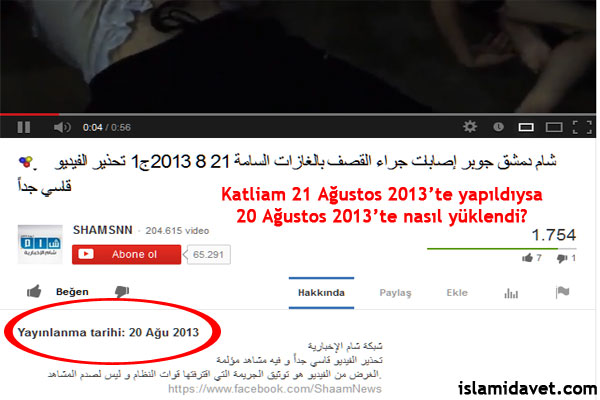
Even if we regard the chemical attack as taking place at 03:30, it is impossible to take the film of the scene and uploading those tens of videos… this shows that terrorists prepared and organized all of the scenes beforehand then accused the Syrian regime of a massacre that terrorists carried out.
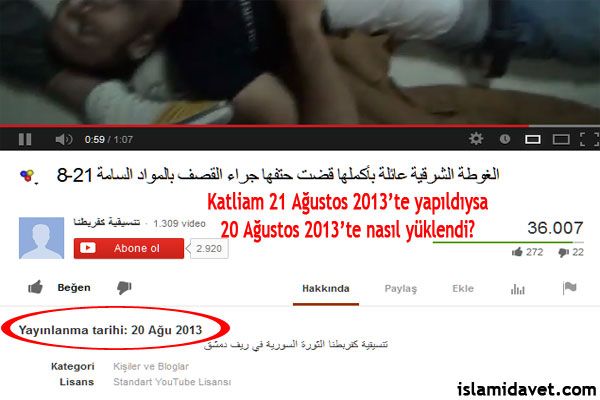
They did not even have mercy for the children and used them to deceive the public. They gathered all civilians, women and children to certain areas and then killed them brutally, then blamed the Syrian regime in order to legalize their brutality.
Published on Aug 20, 2013
تنسيقية كفربطنا الثورة السورية في ريف دمشق
Syrian Chemical Weapons Attack: "I Have not Seen Such Death in My Whole Life"
The Syrian government is facing growing pressure to allow an international probe of an alleged chemical weapons attack on the outskirts of Damascus. The Syrian opposition says government forces fired poisonous gas into rebel-held neighborhoods of Ghouta, killing hundreds of people. Video posted on YouTube this week shows frantic scenes of overwhelmed hospitals, dead children and countless bodies. If confirmed, it would stand to be the most violent incident in Syria since the rebel uprising began two years ago and one of the worst toxic attacks in decades.
The alleged attack occurred just days after U.N. inspectors arrived in the country to investigate previous attacks. We are joined from Syria by Razan Zaitouneh, a lawyer and human rights activist who works with the Human Rights Violation Documentation Center. "We couldn’t believe our eyes," Zaitouneh says of witnessing the attack’s aftermath. "I haven’t seen such death in my whole life." We also speak with Patrick Cockburn, a longtime Middle East correspondent for the London Independent who recently returned from reporting in Syria. His latest article is "The evidence of chemical attack seems compelling — but remember — there’s a propaganda war on."
Transcript
This is a rush transcript. Copy may not be in its final form.
AMY GOODMAN: The United Nations is pressing Syria to allow U.N. inspectors immediate access to investigate allegations a deadly chemical weapons attack took place Wednesday on the outskirts of Damascus. Syrian rebels say government forces fired rockets laden with poison gas canisters into rebel-held neighborhoods. The government of Bashar al-Assad has denied responsibility. The alleged attack occurred just days after U.N. inspectors arrived in the country to investigate previous attacks said to have involved poison gas. Estimates of the death toll from the alleged attack on Wednesday range anywhere from 100 to up to 1,600. Video posted on YouTube this week shows frantic scenes of overwhelmed hospitals, dead children and countless bodies. If confirmed, Wednesday’s attack would stand to be the most violent incident in Syria since the rebel uprising began two years ago.
In an interview with CNN’s Chris Cuomo that aired today, President Obama described the alleged attack as a "big event of grave concern."
PRESIDENT BARACK OBAMA: When you start seeing chemical weapons used on a large scale—and, again, we’re still gathering information about this particular event, but it is very troublesome. And then—
CHRIS CUOMO: There’s strong proof they used them already, though, in the past.
PRESIDENT BARACK OBAMA: Then that starts getting to some core national interests that the United States has, both in terms of us making sure that weapons of mass destruction are not proliferating, as well as needing to protect our allies, our bases in the region. So, you know, I think it is fair to say that as difficult as the problem is, this is something that is going to require America’s attention, and hopefully the entire international community’s attention.
AMY GOODMAN: To find out more about the situation in Syria, we’re joined by two guests. Razan Zaitouneh is in Syria, lawyer, human rights activist. She works with the Human Rights Violation Documentation Center. In 2011, she was co-recipient of the European Parliament’s Sakharov Prize for Freedom of Thought.
Patrick Cockburn is a longtime Middle East correspondent for the London Independent. He just returned from Syria last month. His most recent article for The Independent is called "The Evidence of Chemical Attack Seems Compelling—But Remember—There’s a Propaganda War On." He’s joining us via Democracy Now! video stream from Ireland.
We welcome you both to Democracy Now! I want to turn first to Syria. I want to turn first to talk about what actually is happening in the area of the alleged chemical attack, Razan Zaitouneh, which is where you are. Tell us what you saw.
RAZAN ZAITOUNEH: Thank you.
First of all, just let me explain a bit about our area. This liberated East Ghouta is being shelled every day from air and land, and is—and under brutal siege. For more than 10 months, there’s no electricity, no communications. Hospitals and other facilities are using generators only when there is a fuel. All medications have expired or were run out time ago. This siege prevented locals get even any bread. With all this terrible human conditions, the regime launched a chemical attack on civilians two days ago.
At the beginning, we thought that it’s like the previous times, that there will be only dozens of injured cases and number of murders, but we were surprised by the great numbers which the medical points received during only the first half of hour following the shelling. Things started to become clearer after that. Hours later, we started to visit the medical points in Ghouta to where injured were removed, and we couldn’t believe our eyes. I haven’t seen such death in my whole life. People were lying on the ground in hallways, on roadsides, in hundreds.
There haven’t been enough medical staff to treat them. There is not enough medications for more serious cases. They were just to choose to whom they will give the medication, because there is no medication for everybody. Even doctors were crying because they couldn’t help the injured people, because the lack of the medication and oxygen. The paramedics were telling us how they were breaking in doors and houses in Zamalka and Ain Terma, where the shelling took place, and get inside and find whole families dead in their beds. Most of the children didn’t make it.
In cemeteries which we visited, victims were buried in mass graves, 15 or 20 dead bodies in every grave because the large number of injured people. People were—also there was hysterical between the people. Families are searching for their children. People were searching for their children in every town in Ghouta. Children in the medical points were crying and asking for their parents. It wasn’t believable.
AMY GOODMAN: Razan, how do you know who was responsible for the attack?
RAZAN ZAITOUNEH: This is—if this is the question—first of all, if you believe that we are a crazy people who would kill themselves and their children, then you can ask such a question.
AMY GOODMAN: Did you—since you were in the area, was there any physical evidence that you saw that the government was responsible for this?
RAZAN ZAITOUNEH: That the rockets which was used for the shelling coming from the regime forces, it’s clear. There is no doubt about it. And why wondering? The Syrian people killed hundreds of people when the Arab observers mission was there, and they turned a blind eye to it. So what made you think that? After 100,000 victims and after all that crimes committed by the regime, the regime is not able to do anything to stay in power.
AMY GOODMAN: Let me bring Patrick Cockburn into this conversation. You returned from Syria about a month ago. What is your assessment of what has taken place, these gruesome videos that we’re seeing on YouTube?
PATRICK COCKBURN: Yeah, they’re compelling and convincing. What’s extraordinary is, you know, as we’ve just heard, that this—the area is sealed off and is being bombarded with artillery. Why should they suddenly shift to chemical weapons, which is to kill people, when this is the one thing most likely to lead to a foreign intervention? That seems pretty extraordinary. It’s not an argument they didn’t do it, but I do find that very strange. But, you know, as we heard, this area is sealed off. You know, you can see—if you’re in the rest of the city, you can see the checkpoints and the barricades cutting off this area, not many people getting out—I mean, none, when I was on the other side of the barricades. So, people are trapped in there. So—but it is rather still quite extraordinary that this should happen, since, as we know, they were killing people previously with artillery.
AMY GOODMAN: This point Razan made, why would they care how they kill people, why is this such a shock—the government? Patrick Cockburn, talk about the significance of chemical weapons being used, whoever is using them.
PATRICK COCKBURN: Well, you know, what is the main fear of the government? It is foreign intervention. Otherwise, there’s a stalemate, but the government in a pretty strong position because it controls most of the—almost all the 13 out of 14 of the provincial capitals of Syria. What is the main objective of the opposition is to attract foreign intervention. That’s a reason for the skepticism, or why people look at all these YouTube film of these terrible events and are skeptical and need proof. It’s also true that there’s a sort of YouTube war that’s been going on, and so people are probably less convinced by YouTube evidence than they would have been two years ago, because they’ve been—so many have been manipulated. As I said, this doesn’t mean that it’s happened in this case, but it does explain the skepticism outside.
AMY GOODMAN: I want to play a clip from the State Department’s press briefing on Thursday. Spokesperson Jen Psaki said opposition forces don’t have the capability to use chemical weapons.
JEN PSAKI: If the regime has nothing to do with these attacks, if there was not a use of chemical weapons here, there’s no reason they wouldn’t let the U.N. team that is on the ground, available, happy to investigate, in to do just that. So, that’s what we’re continuing to encourage.
REPORTER: So, would you say that—the Russians are saying that source may have been the opposition. Do you dismiss that out of hand from that podium? Do you dismiss the possibility that the opposition may have actually used chemical weapons?
JEN PSAKI: We still believe that they don’t have the capability to use chemical weapons. That has not changed. Again, we’re looking into the facts on the ground. But there’s no reason, if there’s nothing to hide, for the regime not to let the investigative team in.
AMY GOODMAN: That was the State Department spokesperson, Jen Psaki. Patrick Cockburn, your response?
PATRICK COCKBURN: Yeah, I mean, that’s not unreasonable. The Russians, as I understand it, are now saying that the—they’re encouraging the Syrian government to let the U.N. team go in. Of course, this is all going to remain in dispute, whatever happens. But having a U.N. team there does mean that more facts, more direct eyewitness would be available. Hopefully, it would discourage this happening again. But, you know, it’s extraordinary, as I said, that it’s happened at all—extraordinary and appalling.
AMY GOODMAN: Razan Zaitouneh, the questions that Patrick Cockburn is raising, your response to them?
RAZAN ZAITOUNEH: Actually, I want just to ask why the regime would care about not using the chemical weapons, when it knows that the international community would not do anything about it, like it did nothing about all the previous crimes the regime committed against its people? The international community doesn’t concerned about making any move to get rid of this criminal regime. The regime knows that Obama’s red line are just a big fat lies, so why the regime would care not to use the chemical weapons or any kind of weapons to stop the progress of the Syrian Free Army from the capital, Damascus?
AMY GOODMAN: Patrick Cockburn?
PATRICK COCKBURN: Well, I don’t think—you know, what happened, I don’t know. I doubt if the government in Damascus is quite as sure as that, that there won’t be foreign intervention. I don’t think they’re 100 percent sure. That’s why it makes this event still perplexing. So, you know, was it ordered from the top, if it was by them? Why did it happen? All this remains still somewhat mysterious.
AMY GOODMAN: Razan Zaitouneh, what do you want to see happen now? It is a question we’ve asked you for two years.
RAZAN ZAITOUNEH: The committee is only a few hundred meters from us. Let the committee in. If we are a crazy people who kill themselves and their children, let the committee say that. Let it in to investigate what happened.
AMY GOODMAN: Patrick Cockburn, what do you think needs to happen to deal with this crisis?
PATRICK COCKBURN: Well, I agree with that. I think that letting the U.N. in is exactly what should happen. I think letting the U.N. all over Syria is what should happen. You know, does this stop the killing? No. Does it—is it likely to limit it? Yes. I don’t—there’s a stalemate in Syria, which isn’t going to end. I don’t think that using these weapons is a last-ditch attempt by the Syrian government to prevent it being overrun by the insurgents. So, I think that the stalemate is rather set in steel at the moment. And what is needed is not—is the U.N. to go into this area to see what happened. It needs to go to other areas. One needs to have ceasefires, or a ceasefire. That’s probably the maximum that one could obtain at the moment.
AMY GOODMAN: And, Razan Zaitouneh, your response to that? Razan, are you still there? Let me ask Patrick Cockburn—we’ll try to reconnect with Razan. But The New York Times published an article today headlined, front page, "American Tells of Odyssey as Prisoner of Syrian Rebels." It begins: "Matthew Schrier was helpless. An American photographer held in a rebel-controlled prison in the Syrian city of Aleppo, he and a fellow prisoner had been caught trying to gouge a hole in their cell’s wooden door. The captors took his cellmate, he said, beat him, [and] brought him back with blood-streaked ankles and feet.
“Now was Mr. Schrier’s turn.
“Wearing masks, his jailers led him out, sat him down [and] forced a car tire over his knees. They slid a wooden rod behind his legs, locking the tire in place. Then they rolled him over. Mr. Schrier was face down on a basement floor, he said, legs immobilized, bare feet facing up. ...
"For seven months, Mr. Schrier, [who was] 35 [years old], was a prisoner in Syria of jihadi fighters opposed to President Bashar al-Assad. Held in bases and prisons run by two Islamist rebel groups, he said, he was robbed, beaten [and] accused of being an American spy by men who then assumed his identity online," and were writing to his family, etc.
Again, I was quoting from The New York Times. Patrick Cockburn, your response to this?
PATRICK COCKBURN: Yes, I mean, you know, there are more kidnappings of journalists over the last year, but that’s only the very tip of an iceberg which affects all Syrians, that for the last year and longer one of the threats to any Syrian is of being kidnapped. You know, we tend to focus on the dead and the wounded and the refugees, but one of the most frightening things that can happen to anybody is the fear that their children or their relatives are going to be arrested, are going to be kidnapped, tortured, held for money. And that’s one of the parts of the Syrian—crucial parts of the Syrian nightmare that I think the outside world haven’t really focused on. It happens mostly in around Aleppo, when this—in the north, under rebel-controlled areas, where there’s a complete breakdown of any law and order. But it happens also in Damascus. And you never know when you’re safe. All over Syria, there are checkpoints—government checkpoints, opposition checkpoints, bandit checkpoints. You don’t know who’s going to stop you, what group they’re working for.
AMY GOODMAN: Razan Zaitouneh, I want to bring her in, as well. This description of being captured by—these were rebel forces. Of course, there are many different groupings of them.
RAZAN ZAITOUNEH: I’m sorry, I didn’t hear the most of the conversation. Only the last few words I heard.
AMY GOODMAN: Well, there was a front-page piece—
RAZAN ZAITOUNEH: Are we understood correct?
AMY GOODMAN: There was a front-page piece—
RAZAN ZAITOUNEH: Yes.
AMY GOODMAN: —in The New York Times about an American journalist who was held by jihadi rebel forces in Syria for many months and tortured, until he escaped.
RAZAN ZAITOUNEH: We are not trying to say that there is a lot of mistakes and violations in the revolution. We even observe these violations, make stand against them, try our best to correct the mistakes. We have been saying for long months, help the liberated areas to have very strong police system, to have strong judicial systems. Nobody care. Nobody heard about it. Now, after it is caused, now, after, it’s very difficult to control things. People are starting—or the world are starting to complain about the cowards in that areas and about the violations. Anyway, we will still try to fight these phenomenons and start to fight those rebels who are against our principles of our revolution.
AMY GOODMAN: Razan, you’re in the area of Ghouta right now? Is that where you’re speaking from? Is that where you were? And what is your sense of whether the government will allow in U.N. inspectors to this area? Did you see any independents there looking at the situation?
RAZAN ZAITOUNEH: Yes, I’m in East Ghouta, and we have been trying for the last two days to reach the committee, but in vain. We tried to reach some governments, Western governments, to help us to reach the committee and let—and try to let them in, but also in vain. Until this moment, there is no independents’ eyes get inside Ghouta to see what had happened.
AMY GOODMAN: Patrick Cockburn, your final comment, in the period that you were there, about a international response and what at this point the West should do? Of course, President Obama talked about that line in the sand being chemical weapons. You see the United States moving more, as well as the United Nations. What would you think would be the critical step now?
PATRICK COCKBURN: I think the overall critical step is to try to have a ceasefire in Syria. I don’t think there’s any other solution. I think the bitterness, the hatred, the number of dead is so great that there isn’t going to be any solution to this. But you might be able to arrange a ceasefire. Secondly, that this ceasefire should be heavily monitored by the U.N. Is this going to last? Well, maybe not, but maybe it can prevent events like what has—appears to have happened this week happening again. Perhaps one could move on from there. But I think there’s a need to do that, rather than the sort of every so often it looking possible that there will be foreign—major foreign intervention, military intervention, which I don’t think will happen. But there needs to be a Geneva conference. There needs to be a ceasefire arranged. There needs to be the U.N. there.
AMY GOODMAN: I want to thank you both for being there, Patrick Cockburn, for joining us from Ireland, Middle East correspondent for the London Independent, returned from Syria last month, most recent article for The Independent, "The Evidence of Chemical Attack Seems Compelling—But Remember—There’s a Propaganda War On," he writes. Razan Zaitouneh, joining us from the area of the alleged chemical attack, lawyer, human rights activist, who works with the Human Rights Violation Documentation Center, was co-recipient of the European Parliament’s Sakharov Prize for Freedom of Thought.
This is Democracy Now! When we come back, we’ll talk about Chelsea Manning, headed to Fort Leavenworth. Chelsea Manning, who is the—the name that Bradley Manning has decided to take on as he says he transitions to becoming a woman. Stay with us.
Lead Gardasil developer clears conscience, admits vaccine is useless and deadly
Thursday, August 15, 2013 - By Ethan A. Huff
 Did you know that one of the lead researchers involved with developing the two available vaccines for human papillomavirus (HPV), Gardasil (Merck & Co.) and Cervarix (GlaxoSmithKline), admitted back in 2009 that the jabs are essentially useless and more dangerous than the very conditions they are hailed as preventing and treating?
Before the vaccine industry apparently convinced her to change her story -- you can read more about the saga here -- Dr. Diane Harper, a key developer of Gardasil, is on the record as having cleared her conscience about this fraudulent vaccine, which has been shown to be both ineffective and dangerous.
One particular quote, which was pulled up using the Way Back Machine, reveals both Gardasil and Cervarix do nothing to prevent cervical cancer, which is their primary claim to fame. A 2009 article published by CBS News, in fact, which is still available online, reveals the truth about these snake oil vaccines.
"The rate of serious adverse events (from Gardasil) is on par with the death rate of cervical cancer," admitted Dr. Harper at that time, refuting a pro-Gardasil piece published by Slate. "Gardasil has been associated with at least as many serious adverse events as there are deaths from cervical cancer developing each year."
Dr. Harper went on to admit that deaths from Gardasil have been under reported by the U.S. Centers for Disease Control and Prevention (CDC), which has given the illusion that the vaccine is somehow safe. Beyond this, Dr. Harper dropped a bomb when she told reporters that the public health benefit of getting vaccinated with Gardasil "is nothing," adding that the vaccine has led to "no reduction in cervical cancers."
This admission by Dr. Harper rocked the conventional medical system, which has repeatedly lied to the public with claims that getting vaccinated for HPV will prevent the most common forms of cervical cancer. Because of these lies, literally millions of young girls and now boys, some as young as nine years old, have received the deadly jab since it was first introduced back in 2006.
Beyond this, Dr. Harper is on the record as having told attendees of the 4th International Public Conference on Vaccination back in 2009 that the vast majority of HPV infections resolve themselves on their own within a year, and nearly all of them within two years. She also admitted that an extremely small number of people experience symptoms from infection.
Dr. Harper suddenly retracts statements, claims they were made up
But not long after clearing her conscience on this important issue so that she could sleep at night, Dr. Harper basically retracted all of her statements, claiming that media reports citing them were made up. What? The vaccine industry or some other power apparently got to Dr. Harper and convinced her to change her story -- either that or she is schizophrenic.
In any case, the truth about Gardasil and its counterpart Cervarix has been revealed, and still nothing has been done to pull the vaccine from the market. States like California and Michigan are actually administering these two vaccines to some children without parental consent, and many other states are "mandating" it for students who enroll in public school.
Meanwhile, there are many natural, homeopathic-based remedies that actually work to prevent diseases like HPV that are being ignored by the medical system.
To learn more about the dangers of HPV vaccines, be sure to check out SaneVax, Inc.:
http://sanevax.org/
You can also keep up-to-date with vaccine news you are likely not hearing about from the mainstream media by visiting:
http://vactruth.com/
Sources for this article include:
http://www.naturalnews.com
http://science.naturalnews.com
http://science.naturalnews.com
Lead Developer for HPV Vaccine Admits it is Useless and Dangerous
Mike Barrett - August 22, 2013
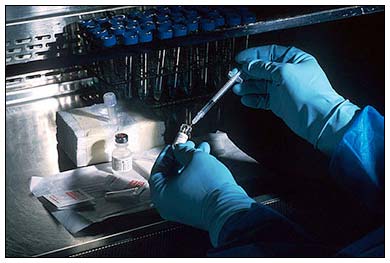 The two vaccines currently available to ‘treat’ human papillomavirus (HPV), Gardasil, distributed by Merck & Co., and Cervarix, distributed by GlaxoSmithKline, are ‘useless and dangerous’ according to one of the lead researchers involved in their development.
Back in 2009, Dr. Diane Harper, admitted that the vaccines were likely more dangerous than the disease they were trying to prevent, that is, until Big Pharma companies persuaded her to change her tune. Dr. Harper is a practicing OBGYN, and she has said that “approximately 70% of women who contract HPV are going to clear that all by themselves within the first year, with no help from anyone,” which includes the interference of GlaxoSmithKline and Merck & Co.
Furthermore, within 2-years, she says that 90% of those infections are going to clear all by themselves.
Only 10% of HPV cases progress into a pre-cancerous lesion. While that is still not good news for women who develop this possibility for cancer, the vaccines themselves are likely more harmful than helpful. In Kansas City, a teen recently suffered from significant health problems after receiving the HPV vaccination, but her doctor said that ‘the benefits outweigh the risk of side effects.” Madie Moorman suffered “debilitating migraine headaches, nausea, insomnia and difficulties processing information, something she calls brain chaos.” These are not insignificant side effects considering only 10% of women who contract HPV will never need to worry about it. She also developed lots of food allergies and cannot focus in school anymore.
Read: The Gardasil Timeline: A History of Corruption and Adverse Reactions
In one article published by CBS News, Dr. Harper even says, “The rate of serious adverse events (from Gardasil) is on par with the death rate of cervical cancer. Gardasil has been associated with at least as many serious adverse events as there are deaths from cervical cancer developing each year.”
Merck & Co. was recently sued by plaintiffs who experienced similar debilitating side effects. Over 230 women suffered complete debilitation after getting a Gardasil vaccination. These side effects ranged from convulsions which were so pronounced and painful that a woman could no longer walk, others suffered miscarriages and anaphylaxis. Despite these obvious and severe problems, HPV vaccinations have been recommended in ‘high-income’ countries, by none other than the World Health Organization.
- You are here:
-
Home

- News