

Alcohol Consumption Health Hazards
- By Bahram Maskanian - December 20, 2012
Alcohol is Not Your Friend: Alcohol, a highly addictive and damaging substance, a deadly poison, current scientific evidences suggest that even a low level of drinking are associated with a high risk for coronary heart disease and much more.
Any amount of alcohol intake raises the risk for dementia, seizure, severe depression, suicide, cardiovascular diseases: high blood pressure, stroke, heart disease, chronic pancreatitis, certain cancers, deadly automobile crashes, over 50,000 per year killed, in U.S. alone.
Alcoholic induced violence is huge staggering number, 89% percent of violent crimes, such as rape, manslaughter and murder are committed under the influence of alcohol.
High blood sugar and diabetes, hepatitis, erectile dysfunction in men, because of fat built-up within the blood vessels, causing numbing of the sensitive sexual organs, due to lack of nutrients and oxygen, women drinking causing birth defects, and overall infant mortality, deaths and infectious diseases.
Alcohol causes cirrhosis of the liver, inflammation of the pancreas, and damage to the nerves system, brain and heart. Drinkers are also at risk of malnutrition because alcohol contains high level of sugar. The digestive system of alcoholics has reduced ability to absorb certain vital nutrients, causing many other illnesses.
We, the humankind have a tendency to runaway from our problems and sedate ourselves using a variety of different substances. And it always begins with a small dosage of whatever narcotics we choose to use. No one becomes alcoholic, or cigarette smoker, or a drug addict overnight. In case of alcohol, it begins with a glass of wine, or a beer. Shortly after we drink 2, or 3, or 4 to maintain the same level of high we had from the first beer, or glass of wine. And that is where we shift to stronger liquors, drinking more and more, chasing our first high in this costly and deadly race.
All of our bad idiotic decisions, actions and behaviors are direct affects of alcohol abuse. Alcohol is a highly dangerous poison and it causes enormous havoc to all aspects of our lives, ranging from: mental retardation, physiological, psychological and personality disorders, blackouts, forgetfulness, learning disability, out of control violent outburst, leading to incarceration, injuries, loss of limbs, and 100,000s death. - Drunk driving auto collisions causing 100,000s of deaths and dismemberment. - Fact is that 86% of all violent criminal conducts are committed under the influence of alcohol.
All of our incredibly stupid and degrading social activities, harmful behaviors toward our loved ones and family, destruction of our health, wealth, self-confidence and self-respect are also caused by alcohol. - Demolition of our one and only BRAIN, and much, much more is caused by alcohol consumption. - And after reading this article if you still not convinced, you are an alcoholic and should seek help to give up this deadly poison.
Alcohol harms our Brain - Doctors have now revealed that alcohol is highly damaging to the Brain Nerves Cells. - Alcohol kills our Brain cells and disarms us from our faculties. - The fact is that all of our human attributes, health regulation, personality, character, attitude and behavior, wisdom, intelligence, decision making and thinking ability, love, affection, understanding, memory, ability to learn and remember, and much, much more are housed and stem from our Brain. We should be highly protective of our Brian, our Brain is who we are…
Alcohol harms our Cardio-Vascular System - the heart and blood vessels are our one and only life giving and sustaining engine. Alcohol constricts and blocks heart’s blood vessels, and all other blood vessels throughout our body. Alcohol harms our liver, destroying liver cells, replacing them with fat. Alcohol causes Cirrhosis of liver, a deadly disease.
Alcohol harms our Stomach - Doctors have now revealed that alcoholic drinks of all kinds cause the lining of the stomach to irritate leading to ulcers and eventually bleeding in the stomach. This can be very serious.
Alcohol ~75,000 (not counting auto accidents - add another 25,000)
The good news is that if given a chance, our body will heal and repair itself. It is never too late to stop, seek help and begin a whole new healthy life. Remember all studies suddenly produced on TV, radio and newspapers are paid advertisements to promote distil industries alcoholic poison. We must be smart and not believe a word of these so-called studies.
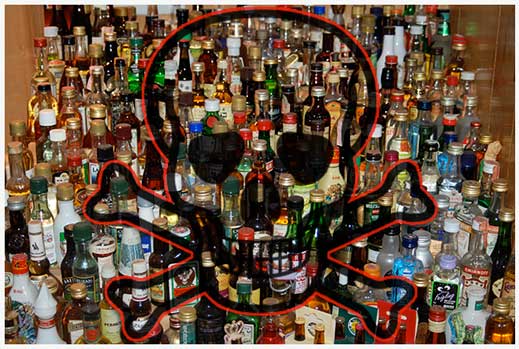
Healthy Mind is in a Healthy Body.
Doctors all over the world have now revealed that our body constantly rebuilds and renews itself. Which it obviously means that is never too late to stop and allow oneself to get well and recover from all the damages we have done to our body. Our Brain also has the capacity to repair itself and begin again, its healthy functions with a help of good holistic organic foods and at least 1 hour of mild cardiovascular exercise a day.
Our Brain health and well being, is the only path to having a successful and prospers life all around; to be in a good physical and psychological shape means never touching alcohol, of any kind. Healthy strong BRAIN generates and maintains our physical health, clarity of mind, bright, healthy, positive, sensible, intelligent, loving character and personality.
Facts and Figures
Did you know that an average of one person dies every 3 minutes from alcohol-related traffic crashes?
In the US, an estimated 50,000 individuals under the age of 21 die each year from injuires caused by underage drinking 19,000 of these are a result of motor vehicle crashes.
Or that every 2 minutes one person is injured from such crashes?
Or that one in every three people will be somehow affected by impaired driving in their lifetime?
Did you know that there has been nearly a 30% increase in women driving under the influence?
In 2007 there were 121,998 alcohol-impaired driving fatalities.
In 2007 total drunk drivers caused accidents and fatalities of innocent people 41,059.
In 2007, over 1.4 million drivers were arrested for driving under the influence of alcohol or narcotics.
These statistics are powerful and understanding the numbers is a critical component in having the knowledge to take a stand in the fight against impaired driving!
The Signs and Symptoms of Alcohol Poisoning
• Person is known to have consumed large quantities of alcohol
• Person is unconscious and cannot be awakened
• Person has cold, clammy, unusually pale or bluish skin
• Person is breathing slowly or irregularly, less than 8 times a minute or 10 seconds or more between breaths
• Person vomits while passed out and does not wake up during or after
Steps to Taking Action
1. Try to wake the person. Try to wake the person by calling their name, slapping their face, or pinching their skin. See if you can get a reaction that will wake the person up. Remember, just because they wake up doesn't mean they are fine. Alcohol stays in the bloodstream until it is processed and just because you can get some reaction at 1:00 AM doesn't mean they will still be conscious by 2:00 AM. Do not leave the person alone.
2. Check the person's breathing. Evaluate if the person has slow or irregular breaths; less than 8 times per minute or more than 10 seconds between breaths. If they are not conscious or barely able to wake up, we need to make sure they don't choke on their own vomit.
3. Turn the person on his/her side to prevent choking. If they are not conscious or barely able to wake up, we begin by making sure they don't choke on their vomit. Start by putting their arm above their head. Bend their opposite knee and roll them toward you so that they are laying on their side, preferably their left side. Putting the person on their left side will slow the delivery of alcohol to the small intestine and also allows more air to surface from the right lung. This way, if they do throw up, the vomit will have a better chance of coming out.
4. Do not leave the person alone. Although it might be inconvenient, it is important to stay with someone who is extremely drunk and barely conscious. Continue to monitor their breathing, responsiveness, skin and lip color, etc.
5. If any of signs of alcohol poisoning exist, call 911 or follow your campus emergency procedures, immediately. Hesitating can mean the difference between life and death.
Stand by your decision. Stand up for your friendship. Do the right thing based on your best judgment and your knowledge of alcohol poisoning. You are always doing the right thing by getting help.
Alcohol Poisoning
Alcohol Poisoning is a real occurrence taking place on college and university campuses. Some students are drinking heavily and quickly and becoming medical emergencies, or worse – fatalities. Certainly, most students don’t drink to excess and campuses and peer education groups are doing everything they can to educate students to prevent a tragedy from happening. However, when all the educational programs are over, sometimes it all comes down to friendship.
Alcohol poisoning occurs when someone puts a large amount of alcohol into their system. There are a lot of reasons why people drink; to be social, they like the feeling of being impaired, to be less self-conscious, to forget their problems, - we could go on and on. But there is a difference between drinking and drinking way too much.
Alcohol poisoning is an overdose of alcohol. Alcohol poisoning is deadly. The brain begins to shut down involuntary functions that regulate breathing and heart rate sometimes resulting in death. The amount of alcohol that causes alcohol poisoning is different for every person. It is not possible to accurately predict for each person what amount will cause them to overdose.
When we hear of a person who has died as a result of alcohol poisoning, typically one of two things happen.
- The person stopped breathing. The depressant level of the alcohol was so high that the drinker simply stopped breathing and his or her heart stopped beating.
- The person choked on their vomit. The drinker passed out, was laying on their back, threw up and choked on his or her vomit.
Alcohol Abuse and Your Health
Alcohol Abuse and Health Risks
There are long-term health risks associated with drinking alcohol over time. These risks include damage to the heart, liver, and brain. However, it should be noted that the vast majority of alcohol health risks could also occur over the course of a single evening. Teenagers, or college-aged students has a much higher risk of an alcohol-related injury caused by a car crash, slipping or falling, getting into a fight, etc. than developing cirrhosis of the liver.
Still, these long-term health risks are important to know because if a person is currently a heavy drinker, has been so in the past, or plans on continuing drinking in this manner in the future, that person ought to know the consequences and damage. There are a number of long-term health risks involved with chronic alcohol abuse; risks in addition to other physical effects such as weight gain, dry skin and a compromised immune system.
Alcohol and the Liver
Alcohol-induced liver disease (ALD) is a major cause of illness and death in the United States. In fact, the U.S. National Center for Health Statistics, 20046 reports that chronic liver disease and cirrhosis rank among the top 10 leading causes of death in the nation. ALD comes in several different forms, some more severe than others.
The first, and least serious, of these, is fatty liver. Fatty liver is just what it sounds like, a buildup of fat in the liver. Fat buildup is not normal and is usually indicative of a more severe liver problem. A more serious liver condition is alcoholic hepatitis; characterized by persistent inflammation of the liver, alcohol hepatitis can cause scarring and hardening of the liver. When scarring becomes extensive, the condition is called cirrhosis, which is very serious and often fatal.
All of these contribute to the death of liver cells. The presence of damaged cells triggers the body’s defensive responses resulting in a vicious cycle of inflammation, cell death, and eventually organ failure, ensuring the necessity of a liver transplant.
Liver cancer is a very real and very serious health risk of alcohol drinking. Deaths from liver cancer are higher among heavy alcohol users than people who do not drink. By altering the liver’s ability to metabolize some carcinogenic substances into harmless compounds or to disable certain existing carcinogens, alcohol’s effects may influence liver cancer.
Alcohol and the Heart
Drinking any amounts of alcohol can raise the levels of fat in the blood (triglycerides), leading to high cholesterol and cardiovascular disease. It can also lead to high blood pressure, heart failure and increased calorie intake (leading to obesity and a higher risk of diabetes). Excessive high risk drinking can also lead to stroke. Other serious problems related to heart disease and the use of alcohol include cardiomyopathy a disease in which the heart muscle becomes inflamed and therefore doesn't work efficiently, cardiac arrhythmia, (abnormal, irregular heartbeat) and sudden cardiac death.
Alcohol and the Brain
In understanding the various risks faced by 15-24 year olds, it is important to note that brain development significantly impacts decision-making skills. Current research dispels the previously held belief that an adolescent, after undergoing puberty, has a brain that closely resembles that of an adult. According to a study conducted by the National Institute of Mental Health (NIMH) and the University of California Los Angeles (UCLA), “The brain’s center of reasoning and problem solving is among the last to mature…” (NIMH, 2004)7. In this decade long study, the brains of thirteen healthy children and teens, from ages four to twenty one, were scanned every two years using MRI technology. In studying these images, researchers found that, “Areas with more advanced [brain] functions – integrating information from the senses, reasoning, and other executive functions (prefrontal cortex) – mature last” (NIMH)7. This gradual brain development makes adolescents physiologically more prone to risky decision-making that can have dangerous results. The University of Wisconsin-Madison Medical School reports that, “Indeed, the risk of injury or death is higher during the adolescent period than in childhood or adulthood, and the incidence of depression, anxiety, drug use and addiction, and eating disorders increases…It is clear that adolescents think and act differently from adults…” (Kelley, 2004)8.
Additionally, research demonstrates that new, and sometimes dangerous, experiences “…tap into a teenager’s so-called reward system…This is the same set of neurons affected by certain illicit drugs, such as cocaine, that releases dopamine, one of the brain chemicals, or neurotransmitters, that are responsible for arousal and motivation” (Brownlee et al, 1999)9. While new experiences may produce a “rush,” substance use and abuse in young people can cause serious health risks, such as a lasting impact on brain development, chemical balances, and neurological “hardwiring” (Brownlee et. al., 1999)9.
Capturing America, Fact by Fact
- By SAM ROBERTS - The New York Times - December 19, 2012
College graduates have less leisure time than high school dropouts. More people are injured on toilets than by skiing or snowboarding. More households have dogs as pets than cats, but cat lovers are more likely to have multiple pets. And more foreigners visited New York (9.3 million) than any other American city (Los Angeles was a distant second with 3.7 million).
Those facts are among the thousands gleaned from the 2013 edition of the Statistical Abstract of the United States, a compendium of figures that itself may go into the record books after being published by the government since 1878.
The latest version, to be released Thursday online by ProQuest and in print by Bernan Publishing, is the first to be made available privately since the Census Bureau ceased publication with the 2012 edition to save money.
“One of the things people value is the continuity,” said Daniel Coyle, manager of ProQuest Statistical Products. He said that the abstract included 1,420 tables, 14 more than last year, and that only three private sources declined to cooperate. The latest abstract will be updated monthly and will be searchable more specifically than previous versions.
“As data gets bigger and data sites proliferate, we believe that the value of high-level aggregations like the statistical abstract increases rather than diminishes,” he said.
Susan Bokern, the company’s vice president for information solutions, said the price would range from several hundred to several thousand dollars, depending on the size of the institution subscribing.
The annual portrait by numbers reveals sharp contrasts within any given year (most of the latest figures are for 2010 or 2011) as well as a moving picture of how the nation has been changing.
More than 41 percent of births were to unwed mothers, for instance, compared with 33 percent a decade earlier. Student loan debt in households headed by a college graduate soared to $36,809 from $12,373 three decades earlier. Since 1982, the number of federal civilian employees rose by 160,000 while the number of state and local government workers swelled by 6.6 million.
Traffic congestion wasted more time for drivers in Los Angeles than in any other city. Americans are also eating more peanuts and drinking less coffee. The number of federal prison inmates hit a record of nearly 210,000. Utah recorded the highest share of residents with Internet access at home (82 percent) and Missouri the lowest (57 percent).
 Fully 27 percent of households had wireless telephone service only. Airport security agents seized 11,908 box cutters from prospective passengers in 2007. About 30 percent of the nation’s veterans served only during peacetime. Hispanic Americans make up a disproportionate share of carwash workers, as do Asian employees of nail salons and blacks in security services.
Liquor stores outnumber bookstores by three to one (the average household spent $100 annually on reading materials and $2,504 on other forms of entertainment). More Americans belong to a fantasy sports league (10.6 million) than to book clubs (5.7 million). Book club members are outnumbered by avid bird-watchers (5.8 million).
The true history of Christmas - Who invented Christmas?
In recent years, popular histories like “The Battle for Christmas” and “Inventing Christmas,” have shown that many of the holiday’s most hallowed rites, traditions we think of as extending back at least as far as C. S. Lewis’s beloved Middle Ages, were invented less than 200 years ago by such 19th-century literary figures as Washington Irving, Clement Clarke Moore and, of course, Charles Dickens. More than Christian or pagan, Christmas is a Victorian fabrication.
It’s a Narnia Christmas
- By LAURA MILLER - Op-Ed Contributor - The New York Times - December 18, 2008
EVERY Christmas, I re-read C .S. Lewis’s novel “The Lion, the Witch and the Wardrobe.” The holiday seems like the ideal time for an excursion into my imaginative past, and so I return to the paperback boxed set of “The Chronicles of Narnia” that my parents gave me for Christmas when I was 10. For me, Narnia is intimately linked with the season.
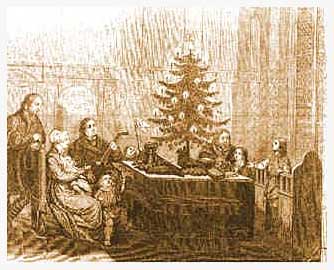 I am not alone. In Britain, stage productions of “The Lion, the Witch and the Wardrobe” are a holiday staple, for good reason. The book rests on a foundation of Christian imagery; its most famous scene is of a little girl standing under a lamppost in a snowy wood; and Father Christmas himself makes an appearance, after the lion god Aslan frees Narnia from an evil witch who decreed that it be “always winter, and never Christmas.”
That I’m not a Christian doesn’t much hinder my enjoyment of either the holiday or the book, but the presence of Father Christmas bothered many of Lewis’s friends, including J.R.R. Tolkien. Tolkien, whose Middle-earth was free of the legends and religions of our world, objected to Narnia’s hodgepodge of motifs: the fauns and dryads lifted from classic mythology, the Germanic dwarfs and contemporary schoolboy slang lumped in with the obvious Christian symbolism.
But Lewis embraced the Middle Ages’ indiscriminate mixing of stories and motifs from seemingly incompatible sources. The medievals, he once wrote, enthusiastically adopted a habit from late antiquity of “gathering together and harmonizing views of very different origin: building a syncretistic model not only out of Platonic, Aristotelian and Stoical, but out of pagan and Christian elements.”
Christmas as we now know it is much the same sort of conglomeration, and when people call for a return to its pure, authentic roots, they’re missing an essential quality of the holiday. Narnia is a mongrel thing, and so is Christmas. As is often the case, this mongrelizing is the source of its strength.
Complaints about the corruption, dilution or fundamental impiety of Christmas have been made for centuries. The Puritans so mistrusted the holiday that its celebration was outlawed in 17th-century Boston. Around the same time, the German theologian Paul Ernst Jablonski asserted that Christmas amounted to a paganization of the authentic faith because the date, Dec. 25, had been appropriated from a festival for a Roman solar god.
(Some Christian scholars, including the current pope, have actually argued that the appropriation went the other way around, and the solar festival was in fact a heathen bid to co-opt the feast day of an increasingly popular monotheistic cult.)
On the other side, non-Christians who relish the holiday like to point out that many Christmas icons — the decorated tree, the Yule log, mistletoe — were originally sacred to Celtic and Northern European pagans.
Yet even the Yuletide customs that are supposedly pagan holdovers must be taken with a grain of salt. We have no written records of the cultures from which they supposedly derive; everything we know about them comes second- and thirdhand from Roman or Christian writers pursuing their own agendas and relying, for the most part, on oral sources.
For decades, historians and folklorists have understood that oral traditions are not very reliable when they refer to anything reputed to have happened more than 100 years ago. What’s presented as hoary legend is in fact more likely a justification of present conditions than an accurate account of the past.
Druids, for example, have over the years been refashioned as the descendants of Noah, as bardic romantics, even as sexual egalitarians; in fact, much of what people think they know about the ancient beliefs and rites of Northern Europeans was concocted by early 20th-century occultist outfits like the Ancient Druid Order and Hermetic Order of the Golden Dawn.
The British historian Ronald Hutton describes this sort of thing as indicative of “the power of literary fiction over fact.” We believe what we choose to believe, and Christmas is no exception.
In recent years, popular histories like “The Battle for Christmas” and “Inventing Christmas,” have shown that many of the holiday’s most hallowed rites, traditions we think of as extending back at least as far as C. S. Lewis’s beloved Middle Ages, were invented less than 200 years ago by such 19th-century literary figures as Washington Irving, Clement Clarke Moore and, of course, Charles Dickens. More than Christian or pagan, Christmas is a Victorian fabrication.
Is this, though, such a bad thing? The unifying principle of Narnia, unlike the vast complex of invented history behind Middle-earth, isn’t an illusion of authenticity or purity. Rather, what binds all the elements of Lewis’s fantasy together is something more like love. Narnia consists of every story, legend, myth or image — pagan or Christian — that moved the author over the course of his life.
Our contemporary, semi-secular Christmas is similarly a collection of everything yearned for: warmth, plenty, peace, family, conviviality. Like Narnia, the holiday is a fantasy, but there are times when a fantasy is exactly what you need.
Laura Miller, a staff writer at Salon, is the author of “The Magician’s Book: A Skeptic’s Adventures in Narnia.”
Woman Warrior Found in 2,000 Years Old Tomb in Iran
Gender was determined by DNA testing; archaeologist says.
TEHRAN, IRAN -- These days, Iranian women are not even allowed to watch men compete on the soccer field, but 2,000 years ago they could have been carving the enemy men to pieces on the battlefield.
DNA tests on the 2,000-year-old bones of a sword-wielding Iranian warrior have revealed the broad-framed skeleton belonged to a woman, an archaeologist working in the northwestern city of Tabriz said Saturday.
“Despite earlier comments that the warrior was a man because of the metal sword, DNA tests showed the skeleton inside the tomb belonged to a female warrior,” Alireza Hojabri-Nobari told the Hambastegi newspaper.
He added that the tomb, which had all the trappings of a warrior’s final resting place, was one of 109 and that DNA tests were being carried out on the other skeletons.
Hambastegi said other ancient tombs believed to belong to women warriors have been unearthed close to the Caspian Sea, north of Iran.

- You are here:
-
Home

- News