

Romney’s Dismissal of "Dependent" 47% in Line with Tax Policies Favoring the "Country Club" 1% - Part 1
In a newly unearthed recording released by Mother Jones magazine, Republican presidential nominee Mitt Romney tells a crowd of donors that he thinks 47 percent of Americans are "dependent" on government and see themselves as "victims." The video has ignited what could be the biggest political firestorm facing Romney’s campaign to date. We’re joined by Pulitzer-winning journalist and author David Cay Johnston, a former New York Times reporter and author of several books, including most recently, "The Fine Print: How Big Companies Use 'Plain English' to Rob You Blind." Johnston says Romney’s tax plan is "a plan for dynastic wealth. It is a plan to take care of the already rich. It is not a plan, as he claims, to help the strivers who want to get ahead."
AMY GOODMAN: This is Democracy Now!, democracynow.org, The War and Peace Report. We’re on our 100-city tour. I think we’re in city 16 at this point. We’re here in Chicago. I’m Amy Goodman, as we turn to what could be the biggest political firestorm facing Republican presidential nominee Mitt Romney’s campaign to date. In a newly unearthed recording released by the magazine Mother Jones, Romney tells a crowd of donors [that] he thinks 47 percent of Americans are dependent on government and see themselves as victims.
MITT ROMNEY: There are 47 percent of the people who will vote for the president no matter what. All right, there are 47 percent who are with him, who are dependent upon government, who believe that they are victims, who believe that government has a responsibility to care for them, who believe that they’re entitled to healthcare, to food, to housing, to you-name-it, that that’s—it’s entitlement, and the government should give it to them. And they will vote for this president no matter what. And that—I mean, the president starts off with 48, 49, 48—he starts off with a huge number. These are people who pay no income tax. Forty-seven percent of Americans pay no income tax. So our message of low taxes doesn’t connect. So he’ll be out there talking about tax cuts for the rich. I mean, that’s what they sell every four years. And so, my job is not to worry about those people. I’ll never convince them that they should take personal responsibility and care for their lives. What I have to do is convince the 5 to 10 percent in the center.
AMY GOODMAN: On Tuesday, Mother Jones released the full, unedited 49-minute video of Mitt Romney speaking on May 17th to wealthy donors at the home of controversial private equity manager Marc Leder in Boca Raton, Florida. Tickets for the dinner cost $50,000 a plate.
In comments that have received less attention, Romney is also heard on the original tape joking to his audience that he would have a better chance of selection had he been born a Latino. Also during the dinner, Romney discussed various foreign policy positions that have raised further questions. At one point he says Palestinians have, quote, "no interest whatsoever in establishing peace and that the pathway to peace is almost unthinkable to accomplish," unquote. On the topic of Iran, Romney warned, quote, "America could be held up and blackmailed by Iran, by the mullahs, by crazy people," unquote. Romney also called Middle East peace, quote, "almost unthinkable."
On Tuesday, Mitt Romney appeared on Neil Cavuto’s Fox News show and defended his comments.
MITT ROMNEY: Well, we were of course talking about a campaign and how he’s going to get close to half the vote, I’m going to get half the vote, approximately, I hope. I want to get 50.1 percent or more. And, frankly, we have two very different views about America. The president’s view is one of a larger government. There’s a tape that just came out today where the president is saying he likes redistribution. I disagree. I think a society based upon a government-centered nation, where government plays a larger and larger role, redistributes money, that’s the wrong course for America. That will not build a strong America or help people out of poverty. I believe the right course for America is one where government steps in to help those that are in need—we’re a compassionate people—but then we get—let people build their own lives, create enterprises. We believe in free people and free enterprise, not redistribution. The right course for America is to create growth, create wealth, not to redistribute wealth.
AMY GOODMAN: President Obama addressed Mitt Romney’s comments during an appearance on The Late Show with David Letterman.
PRESIDENT BARACK OBAMA: When I won in 2008, 47 percent of the American people voted for John McCain, they didn’t vote for me. And what I said on election night was, even though you didn’t vote for me, I hear your voices, and I’m going to work as hard as I can to be your president. And one of the things I’ve learned as president is you represent the entire country. And when I meet Republicans as I’m traveling around the country, they are hard-working family people who care deeply about this country. And my expectation is that if you want to be president, you’ve got to work for everybody, not just for some.
AMY GOODMAN: For more, we’re joined right now by Pulitzer Prize-winning investigative journalist David Cay Johnston. He’s a former New York Times reporter, author of a number of books. His latest just came out this week. It’s called The Fine Print: How Big Companies Use "Plain English" to Rob You Blind.
David Cay Johnston, it’s great to have you back to Democracy Now!
DAVID CAY JOHNSTON: Thank you.
AMY GOODMAN: The 47 percent—explain Mitt Romney’s comment.
DAVID CAY JOHNSTON: Well, first of all, he’s conflating totally unrelated things. Many of the 47 percent he’s talking about are people who work. They work at crummy jobs at crummy pay. Because of the Republicans, a married couple with two children does not pay income taxes until they make $44,000 a year. That’s because of the Republicans promoting the $1,000-per-child tax credit. So, he’s actually insulting many of the people who voted or likely would vote for him. Many of the people in this 47 percent, which is a brief anomaly because of the economy, are retirees, people who worked all their lives. Now they’re retired, and because Social Security is their major form of income, they don’t make enough money to pay taxes. This is an astonishing statement by him to suggest that 47 percent of the population are moochers who just live off the government.
AMY GOODMAN: And what about, for example, retired military?
DAVID CAY JOHNSTON: Oh, they would fit in that group. Romney, if he chose to, could arrange his affairs, quite legally, to pay no taxes. When he ran Bain, he could have fallen into this group. He won’t give us his tax returns, so we don’t know. But it would be—it’s very easy for the manager of a hedge fund or private equity fund to have a billion-dollar income and pay no income taxes and not appear in the official government data. So, it’s astonishing. And, you know, his approach to this is very much a sort of country club, have no contact with people who are working-class people or middle-class people. It represents an us-versus-them philosophy, the exact opposite of what you saw in the comments that Barack Obama made about, you know, "I’m president of everybody, including people who voted against me."
AMY GOODMAN: And clearly, he was deeply concerned, Mitt Romney, about this video getting out, because he held a news conference at, what, 10:00 at night—
DAVID CAY JOHNSTON: Yeah.
AMY GOODMAN: —and talked about how maybe he inelegantly spoke.
DAVID CAY JOHNSTON: Well, I don’t think he was being inelegant at all. He was appealing to donors. But, you know, Amy, there’s a deeper question about all the things happening in the Romney campaign. Here’s a businessman who holds himself out as somebody who is a master at figuring out how to make a lot of money off of a business, either buying one and sucking the capital out of it or, in some cases, building one, as he’s done. But he appears to have no plan, no business plan for a campaign, and stumbles from place to place, has not thought through what he’s doing. And that should raise, I think, serious questions in the minds of voters about the man’s judgment and about whether he’s going to be a president who does research and understands how things work and looks at multiple perspectives, or he has an ideological view of the world, and he would impose that, and it would drive all of his decisions as president.
AMY GOODMAN: Can you explain Mitt Romney’s tax plan, David Cay Johnston?
DAVID CAY JOHNSTON: Yes. Mitt Romney’s tax plan is vague. The much fuller explication of it is Paul Ryan’s tax plan. But basically, Romney believes that people whose income comes from capital, like him—from dividends, interest, capital gains, rents—should pay little or no tax. He would exempt a married couple making up to $250,000 from taxes on capital gains and dividends. So you could own $12-and-a-half million worth of stock, collect dividends at the current average rate, and pay no taxes whatsoever.
Ryan would completely eliminate taxes on capital, on estates and on gifts. And if we do that, that is the end of America as a country of entrepreneurs and strivers, whether they’re in profits or nonprofits, like the kind of entrepreneurial activity that you have done in building up this show and maintaining it all these years. We would become like France in the late 18th century, where your economics were determined at birth by who you picked as your parents. And if you didn’t pick parents who were already rich, then you’re going to have a tough life. This is a plan for dynastic wealth. It is a plan to take care of the already rich. It is not a plan, as he claims, to help the strivers who want to get ahead.
AMY GOODMAN: David Cay Johnston, can you just explain how Mitt Romney has been able to keep his tax rate so low, although we don’t know actually how much he has paid because of the refusal to make public his tax returns?
DAVID CAY JOHNSTON: Well, for the one year we have his tax return, his income is almost all what’s called "carried interest." Even though he does not—did not have capital at risk, he was paid fees from Bain Capital, and that turns into dividends, capital gains, which, under the Bush administration’s tax policy, are taxed at 15 percent. That’s the rate paid by schoolteachers. But, of course, Mitt Romney is making over $20 million a year. If you’re a worker who makes that kind of money, you pay 35 percent, not 15.
In addition, Romney pays the taxes on behalf of his five sons. So he put—he and his wife put in property they valued at about a million dollars, certainly no more than $2 million. That trust fund is now worth $100 million, which tells you how porous the gift tax system is in America. And his sons now get tax-free income for life, each of them having roughly $20 million there working for them, and they don’t have to do a thing to get their income from it.
AMY GOODMAN: David Cay Johnston, what is most important to understand about the fine print? And I’m talking about the title of your new book, How Big Companies Use "Plain English" to Rob You Blind.
DAVID CAY JOHNSTON: Well, this book, I spent four years on, Amy. It is original research. This is not anything you will find going to Google. And I show in this book how we have rewritten commercial rules that, some of them, date back thousands of years, that companies now have been raising prices in many industries well above the rate of inflation. There are businesses out there that have gotten rules passed that require you to pay them a tax that they don’t have to pay to the government. Imagine how well off you would be if somebody else paid your taxes. I literally have a large insurance company going to a man paralyzed from the neck down and asking him to die because it was costing too much money to keep him alive. That’s how out of control things have gotten with business in America.
And what Romney and Ryan propose, of course, is to completely unshackle business in America. And all the way through the book, I show how dangerous conditions are propping up all over. We had a whole city block blow up in San Bruno, California, and killed eight people, including, by the way, the California Public Utilities Commission staffer whose job was to investigate the safety of natural gas pipelines, which is what blew up and killed her.
AMY GOODMAN: I want to continue this conversation offline. We’re going to post the conversation about The Fine Print at democracynow.org and play it on the broadcast, as well. Pulitzer Prize-winning journalist David Cay Johnston, I want to thank you so much for being with us. Again, his book, The Fine Print: How Big Companies Use "Plain English" to Rob You Blind.
And that does it for today’s broadcast. If you want to get a copy, you can go to our website at democracynow.org. As we continue our 100-city tour, I’ll be speaking on Thursday night at the Barrymore Theatre in Madison, Wisconsin. And then on Friday in the afternoon, we’ll be in Eau Claire at the Unitarian Universalist Church; in the evening, in Hayward, Wisconsin. And then, on Saturday night, we’ll be in Minneapolis. You can go to our website at tour.democracynow.org to get all the details of this 100-city tour.
GUEST
David Cay Johnston, Pulitzer Prize-winning journalist who writes about tax issues. He is a former New York Times reporter and author of several books, including, most recently, The Fine Print: How Big Companies Use "Plain English" to Rob You Blind.
David Cay Johnston: "The Fine Print: How Big Companies Use 'Plain English' to Rob You Blind" Part 2
In part two of our interview with David Cay Johnston, we discuss his new book, The Fine Print: How Big Companies Use 'Plain English' to Rob You Blind. Johnston writes, "No other modern country gives corporations the unfettered power found in America to gouge customers, shortchange workers, and erect barriers to fair play. A big reason is that so little of the news ... addresses the private, government-approved mechanisms by which price gouging is employed to redistribute income upward."
AMY GOODMAN: We continue our conversation with the Pulitzer Prize-winning journalist David Cay Johnston. His book is called The Fine Print: How Big Companies Use "Plain English" to Rob You Blind.
David Cay Johnston, thank you so much for staying with us. So, talk about the reasons you started to investigate the fine print and what most surprised you as you did your research over these past four years, David.
DAVID CAY JOHNSTON: Well, Amy, this is the third book in a series of all original reporting that you wouldn’t know but for my work. I wrote a book seven years ago called—I’m sorry, eight years ago, called Perfectly Legal, about the tax system and how it really is a subsidy system for the super rich in America and how they’ve rigged the tax game on their behalf. Then I did a book called Free Lunch, and it’s about all the taxes you pay that do not go to the government but instead are diverted to various companies, and I show companies and industries that get all of their profits from the taxpayers through these hidden subsidies.
The Fine Print carries this a step further now to how big businesses have been trying to escape the rigors of competitive markets. They have gotten government to pass rules that raise prices, take away your rights as a consumer, literally put your life in danger, and allow them to, in various ways, insulate themselves from market forces, damaging the economy, making you worse off and explaining why, while wages have been flat for years, corporate profits have gone through the roof.
AMY GOODMAN: You start off with taxes—you know, they’re not for everyone. But explain how that happened, how that evolved, David.
DAVID CAY JOHNSTON: Well, let me give you one example. Twenty years ago, we were told we were going to get something magical called "the information superhighway." And we paid over a half-trillion dollars in rate increases to telephone companies and cable companies to get this high-speed internet with fiber-optic service, where all the books in the Library of Congress and all the images in them, 22 million volumes, in the blink of an eye could literally be moved around the world. Well, we paid for it, but we don’t have it. Verizon is only going to build it out for 16 million people in this country, of 300 million people. AT&T doesn’t actually have that kind of system. Their U-verse, at the end, still uses copper wire, and there are homes that have copper wire in them from the 1800s that people still speak on the telephone with. What they did was take that money, I believe, and use it to build a cellphone system. But they got these rate increases, and we now have gone from inventing the internet to 29th in the world. We’re way behind Moldavia, and it’s damaging our economy. But the more they retard the internet, the more profit Verizon and AT&T make. So their interests are contrary to the interests of the American people.
AMY GOODMAN: What is Mr. Kellogg’s favorite loophole?
DAVID CAY JOHNSTON: Well, that’s from an earlier book of mine. His was one where he put $8,000 a year of business into an offshore company and made a half-a-billion dollars of profit, tax-free. And after I exposed that, he stopped doing it. And I will say, he had the decency to say I had done a good job of exposing what he was doing.
AMY GOODMAN: What most surprised you as you researched your book?
DAVID CAY JOHNSTON: Oh, I was flabbergasted that all of these laws and rules have been passed, especially in state capitols, that there has been literally no coverage of at all. I mean, we have so shrunken the news media in this country and so intimidated news organizations, because, trust me, as somebody who was in the forefront of this, if you’re writing tough stuff, there’s a whole list of people who want to get rid of you and shut you down.
So, for example, Americans have had the right, absolute right, since 1913 to a landline telephone at any address. As long as you pay the bill, you’re entitled a telephone. Five states have now repealed that law, and not a single article appeared in any news organization in those five states. I’m the only journalist who’s written about that, and there are a lot of other stuff I write about that nobody else has written about. But basically, lobbyists, corporate lobbyists, have been getting—quietly getting laws and rules rewritten to favor business, destroy competition and act against consumers by taking away your rights.
AMY GOODMAN: Can you talk about America’s coming infrastructure disaster, a piece you just wrote about?
DAVID CAY JOHNSTON: Yes. That was an excerpt that appeared in Newsweek. Our big utility companies are being hollowed out, even as they’re raising prices tremendously. If you live in—half the states restructured their electric industry. Well, the utilities were allowed to pocket tens of billions of dollars of tax money that had already been paid, because nobody paid attention to the accounting on this. And then, Pacific Gas and Electric in Northern California got rate increases so that they could replace their telephone—their electric power poles on a 50-year cycle. They’re actually replacing them on a 750-year cycle. Well, that means eventually we’re going to have a crisis. The government is now giving safety waivers — they call them "special permits" — to high-pressure natural gas lines, saying, "You don’t have to inspect these lines." Some of these lines run underneath and past schools. And school principals get a brochure that, if they don’t read through about how wonderful the natural gas industry is, on the fifth page it says, "You received this notice because your school is in a high-consequence area." It then tells you nothing about what to do. And, by the way, "high-consequence area" is a euphemism for "zone of certain death." We need to be investing in rebuilding these utilities, not stripping them of money so that the current owners can make bigger profits than a market economy would allow.
AMY GOODMAN: David Cay Johnston, talk about the gas pipeline that blew up in the San Francisco suburb of San Bruno.
DAVID CAY JOHNSTON: Well, all across America, pipelines that were laid when Truman was president are now in areas that were open fields back then, and now they’re developed with housing. And this pipeline blew up an entire city block. It sent flames hundreds of feet into the air. It turns out it was put in the ground with a faulty weld. The mayor of San Bruno tells how after this happened, the city discovered there was a second pipeline running through the city, only because it was going to put a building up on a little tot lot for small children, and the gas company notified them that this 30-inch pipe underneath it was running there. They had no idea.
There’s a lawyer I write about who tried to get the—what are the safety protocols in the event one of these pipelines blows up somewhere? And there’s nothing in the file. The gas pipeline companies have virtually no plans, no "here’s the people to call, here are the resources available to fight a fire." We’ve had several of these explosions where it’s taken an hour to shut off the flow of gas or oil. We almost lost Bellingham, Washington. But for two little boys playing with a butane cigarette lighter who set off an explosion, Bellingham, Washington, would—downtown would be gone. And we need to recognize that we are not running these businesses in a way that respects public safety and reasonable profits. They are being stripped of money, and they are not being maintained, so the current owners can make outsized profits.
AMY GOODMAN: Talk overall, David Cay Johnston, about the issue of deregulation. The whole issue of regulation is one that the Republican presidential candidate raises continually about, you know, unfettered business, free enterprise, capitalism being allowed to work in this country.
DAVID CAY JOHNSTON: There is no such thing as deregulation. This is a really important issue about how the news media have not covered this well. There is only new regulation. And what we’ve done is taken rules, some of which date back thousands of years—and I teach the law of the ancient world at Syracuse University’s law school and graduate business school. We’re stripping these rules away, and we are putting in rules that say you don’t have to have any regard for your neighbor or your employees or your customers; you can do whatever will maximize your profit; it doesn’t matter that you’re putting people’s lives in danger, that you’re not supplying the services you promise, that you’re driving up prices artificially. And nobody has written about these laws. I mean, I had to spend four years reading through the most unbelievably boring material, but it was astonishing how these laws were passed with, in many cases, little or no public hearing, no journalists in the room. Sometimes even the trade press of the various industries I write about didn’t even write about these things.
AMY GOODMAN: When you’re talking about the fine print, just go through example after example, as you did your research over these years, of how people are robbed blind and how you can fight back. But give the specifics, David.
DAVID CAY JOHNSTON: OK. Well, and indeed, one of the things I do in this book is show various ways that you can fight back about this. The pipeline industry, let me go back to them. During the Bush administration, they got an administrative rule passed. They created something that didn’t exist in the law in terms of hearings, so they could have one-sided contact with the commissioners—the industry could—that allows the pipeline industry to collect from their customers—and they’re all captive customers—the corporate income tax. But pipelines don’t pay the corporate income tax, because they’re partnerships. And there’s a court case that shows this increases their profits as much as 75 cents on the dollar. So if you’re going to earn a dollar, you actually get a dollar and 75 cents in your pocket at the end of the day if you own one of these.
Well, the—I wrote a piece in a little publication called State Tax Notes. They were going to try and do this on the state level in California with something called the SFPP pipeline, which is a descendant of the old octopus that strangled California, the railroad operations, in the late 1800s. And three citizens went to the California Public Utilities Commission and said, "We’d like to speak about this," and it killed it right there. The government no longer imposed that rule on the state level in California. This particular tax costs the average family a couple of pennies a day. Nobody’s going to fight with somebody over being robbed of a couple of pennies a day, but if you can get a penny a day from every single person in America, at the end of the year you’ve got $1.1 billion. These companies are collecting several billion dollars a year this way, and they shouldn’t. They’re collecting a tax they don’t pay to the government.
Another example of this is arbitration. If you buy a car, buy a television set, open a brokerage account or a bank account, you sign away your right to sue. Well, in most cases it works fine, but when it doesn’t, here’s what happens. A woman in Washington, D.C., a bus driver, was sold a car for three times what it was worth by one of those outfits that runs TV ads all the time about "We’ll help you get a car." And Wells Fargo financed it. She was going to pay almost $30,000 for this $6,000 vehicle, because she doesn’t understand money very well. And when she was put on disability and said, "I want you to take the car back," they wouldn’t take it back. And then they told her — the collection agent from Wells Fargo — "Wells Fargo will take your house." And this single mother was terrified about it. She found some law students, who took up her case. And because of a mistake that actually was made by someone else, they were able to get a judge to rule this was unconscionable, and the woman eventually got out of this deal. But people get abused that way all the time.
Another example is bounced checks. Thirty years ago, Crocker Bank, now a part of Wells Fargo, had to reveal that they were charging a 2,000 percent markup on bounced checks. It costs 30 cents; they were charging $6. You can now pay $35, $39, $47 for a bounced check, not a check that you bounced because there wasn’t money in your account, but where you deposited a check, even if it’s from your employer. And after the bank said it was cleared, they can unclear it later and charge you that much money.
AMY GOODMAN: Talk about healthcare.
DAVID CAY JOHNSTON: Well, you know, healthcare in America is not a—we don’t have a system of healthcare, Amy. What we have is a system—a non-system system of sick care. We spend so much more money than the French, who have the best healthcare system in the world, according to the World Health Organization, that if we simply reduced our costs to those of France, we could eliminate the corporate income—or, the individual income tax. And think about that. Nobody would have to pay individual income tax, and we could have universal healthcare, and all else would be equal in our economy. And yet, at some point during the year, one in four Americans will not have health insurance, and about one in six will go the whole year without health insurance. We have created a—it’s part of how we are creating a privatized set of rules, sponsored by government, to redistribute upward. And that’s the whole scheme here. It is to redistribute income upward in a way that a market economy would never do that, but a corporate socialist economy, where corporations are able to privatize gains and make you pick up their losses, that’s the kind of economy that we’re moving into.
AMY GOODMAN: David, Mitt Romney continually talks about "redistribution" as a bad word—
DAVID CAY JOHNSTON: Right.
AMY GOODMAN: —a code kind of word in talking about President Obama.
DAVID CAY JOHNSTON: And, in fact, we have redistribution in this country, but it is very much upward. You know, the phrase "trickle-down" was invented to mock Ronald Reagan’s tax policies. But the reality is, it’s not trickle-down, it’s Amazon-up, Niagara-up. And all you have to do is look at the data. From 1961 through 2007, the bottom 90 percent of Americans saw their income rise little tiny amount. But if you’re in the top top group of America, the plutocrat class, for every dollar that each person in the bottom 90 percent got after taxes, you got $35.50—$36.50. Your taxes, if you’re in the plutocrat class, fell from a mid-40 percent range down to where Romney is, 15 percent or so. In 2009, we had six people, according to IRS data, who made over $200 million, who paid no income taxes. And we have people who make billion-dollar incomes and can pay no income taxes because of the rules we have that allow people who are hedge fund managers and private equity managers, like Bain & Company, which was the sole property of Mitt Romney, to defer all of their income. Now, how do they live? Just the same way that the guys who create the internet companies, who take a small salary, and the company pays no dividend, are able to afford their private jets and their mansions: they borrow against their untaxed assets. And they get to live a great life, and—
AMY GOODMAN: David—
DAVID CAY JOHNSTON: —you and I pick up the bill.
AMY GOODMAN: I know that you have to leave, and I just want to get one-sentence answers to each of these questions.
DAVID CAY JOHNSTON: OK.
AMY GOODMAN: How did the Yankees and Mets owners grab like, what—collect $1.3 billion in public funds?
DAVID CAY JOHNSTON: They very quietly got the government to put up the money to build their new stadiums, and the news organizations somehow missed covering that.
AMY GOODMAN: Paris Hilton, her grandfather?
DAVID CAY JOHNSTON: Paris Hilton’s grandfather arranged to essentially steal two-thirds of a billion dollars from the starving children of the earth by subverting his father Conrad Hilton’s will. And he got to keep the money until he died, and then it had to go to charity. And so, imagine if you could have $641 million to use for, say, 30 years, and then you had to give it back. That alone would make you rich.
AMY GOODMAN: Homeowner’s title insurance?
DAVID CAY JOHNSTON: About 90 percent of the money people pay for title insurance goes for what are in fact commercial bribes. The actual payments of damages by title insurance companies are so small that if you gave them 1 percent of the value of your house and let them collect the interest for five years, they could give you the money back, and it would cover all their costs.
AMY GOODMAN: Well, you passed the test, David Cay Johnston, and it’s an amazing book. And as you talk about, finally, the fight back, give us one word of hope.
DAVID CAY JOHNSTON: We got rid of slavery. Women got the right to vote. We got child labor laws. We can fix this, but reform begins with you.
GUEST
David Cay Johnston, Pulitzer Prize-winning journalist who writes about tax issues. He is a former New York Times reporter and author of several books, including, most recently, The Fine Print: How Big Companies Use "Plain English" to Rob You Blind.
Integrity of Internet Is Crux of Global Conference
"To achieve a free, democratic and open world, we, the people, are depending on a free, democratic and open Internet. - The Nation-less corporations and their Governments, working behind closed doors, should not be allowed to direct, censer and control the use of and the future of Internet. - We, the 99.99% billions of people all around the Planet Earth who use and pay for the Internet should control the Internet."
- By ERIC PFANNER - The New York Times - November 27, 2012
PARIS - A commercial and ideological clash is set for next week, when representatives of more than 190 governments, along with telecommunications companies and Internet groups, gather in Dubai for a once-in-a-generation meeting.
The subject: Control of the Internet, politically and commercially.
The stated purpose of the World Conference on International Telecommunications is to update a global treaty on technical standards needed to, say, connect a telephone call from Tokyo to Timbuktu. The previous conference took place in 1988, when the Internet was in its infancy and telecommunications remained a highly regulated, mostly analog-technology business.
Now the Internet is the backbone for worldwide communications and commerce. Critics of the International Telecommunication Union, the agency of the United Nations that is organizing the meeting, see a dark agenda in the meeting. The blogosphere has been raging over supposed plans led by Russia to snatch control of the Internet and hand it to the U.N. agency.
That seems unlikely. Any such move would require an international consensus, and opposition is widespread.
Terry D. Kramer, the former Vodafone executive who is the United States ambassador to the conference, has vowed to veto any change in how the Internet is overseen.
Analysts say the real business of the conference is business. “The far bigger issue — largely obscured by this discussion — are proposals that are more likely to succeed that envision changing the way we pay for Internet services,” Michael Geist, an Internet law professor at the University of Ottawa, said by e-mail.
Hamadoun Touré, secretary general of the I.T.U., has repeatedly said that the U.N. group has no desire to take over the Internet or to stifle its growth. On the contrary, he says, one of the main objectives of the conference is to spread Internet access to more of the four and a half billion people around the world who still do not use it.
And yet, groups as diverse as Google, the Internet Society, the International Trade Union Confederation and Greenpeace warn that the discussions could set a bad precedent, encouraging governments to step up censorship or take other actions that would threaten the integrity of the Internet.
“This is a very important moment in the history of the Internet, because this conference may introduce practices that are inimical to its continued growth and openness,” Vinton G. Cerf, vice president and chief Internet evangelist at Google, said in a conference call.
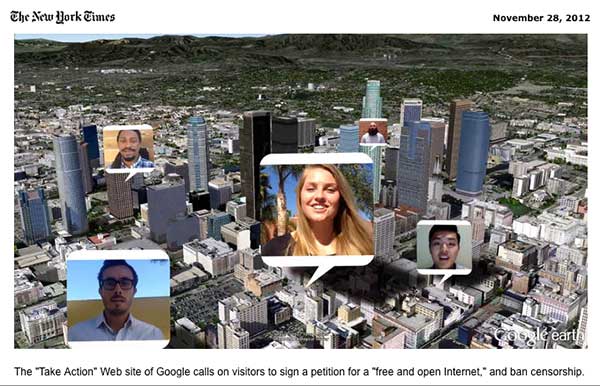
Google set up a Web site last week, “Take Action,” encouraging visitors to sign a petition for a “free and open Internet.” The campaign is modeled on the successful drive last winter to defeat legislative proposals to crack down on Internet piracy in the United States.
More energy is expected to be spent on how companies make money off the Internet. In one submission to the conference, the European Telecommunications Network Operators’ Association, a lobbying group based in Brussels that represents companies like France Télécom, Deutsche Telekom and Telecom Italia, proposed that network operators be permitted to assess charges for content providers like Internet video companies that use a lot of bandwidth.
Analysts say the proposal is an acknowledgment by European telecommunications companies that they cannot hope to provide digital content. “The telecoms realize that they have lost the battle,” said Paul Budde, an independent telecommunications analyst in Australia. “They are saying, ‘We can’t beat the Googles and the Facebooks, so let’s try to charge them.’ ”
The European lobbying group says that without the new fees, there will be no money to invest in network upgrades needed to deal with a surge in traffic. Regulators have required European telecommunications operators to open their networks to rivals, and the market for broadband is fiercely competitive, with rock-bottom prices.
In the United States, by contrast, most telecommunications companies have been permitted to maintain local monopolies — or duopolies, with cable companies — in broadband, keeping prices higher. And American regulators have ordered broadband providers to give equal priority to all Internet traffic. Such “network neutrality” is incompatible with charging content providers for moving their bits of data.
Analysts say this may explain why American telecommunications companies have not joined the European call for a new business model. “Models that try to force payment terms between nations and telecom operators run a huge risk of cutting off traffic,” Mr. Kramer said in an interview. “Liberalized markets are the only way to expand the success of the Internet.”
People who have been briefed on the conference submissions say that not a single European government delegation has endorsed the telecommunications operators’ proposal, and the European Parliament has passed a resolution denouncing it. Only governments, not private groups or companies, can put items on the meeting agenda.
While many documents prepared for the conference remain secret, several people who have seen submissions say there is broad support for Internet connection fees in French-speaking Africa and among Arab nations — countries in which many telecommunications companies are still owned or heavily regulated by governments.
Much of the attention before the 12-day conference has focused on a proposal from Russia that would effectively remove control of the Internet’s infrastructure from a collection of decentralized and apolitical organizations, mostly based in the United States. “Member states,” Russia proposed, “shall have equal rights to manage the Internet, including in regard to the allotment, assignment and reclamation of Internet numbering, naming, addressing and identification resources.”
Those functions are performed by the Internet Corporation for Assigned Names and Numbers, a private organization with an international board that operates under contract with the United States government.
The Russian proposal was widely interpreted as a call to legitimize domestic censorship of the Internet. Yet analysts note that governments inclined to filter the Web, like China and Iran, have not waited for consensus in an international meeting to do so.
All Your Climate Questions Answered in 60 SECONDS!!! - Questions For Corbett #084
Published: February 28, 2022
Daniel writes in to ask a climate question: how can James possibly think that "climate change is a hoax"? James responds in the most succinct way possible. Buckle up, folks!
https://www.corbettreport.com/climatequestions/
Climate Change is Unfalsifiable Woo-Woo Pseudoscience
Science as Falsification
Originally published in "Conjectures and Refutations" (1963). A key discussion in the philosophy of science - by Karl R. Popper
Karl Raimund Popper (28 July 1902 – 17 September 1994) is the creator of Falsificationism as a philosophy of science. According to Popper, there is no such thing as inductive confirmation: theories can only be refuted. Whilst he allowed that theories that had withstood a wide variety of attempts to refute them were thereby ‘corroborated’, he denied that corroboration in this sense could justify belief. He therefore claimed to have solved the problem of induction, due to David Hume and others: there is no such problem because there is no induction.
Popper placed great weight on another problem in philosophy of science: that of distinguishing science from non-science, and especially from pseudoscience. Falsificationism was his answer to this problem too, as the relevant criterion is precisely that any genuinely scientific assertion must be capable of being falsified. For this reason, he maintained, only observation statements, and affirmative universally quantified statements, could properly be counted as scientific. Affirmative existential statements could never be falsified, because to do so would require potentially infinitely many observations.
MI6 Admits to "Green Spying" As Agenda 2030 Noose Tightens - #NewWorldNextWeek
Published: April 30, 2021
This week on the New World Next Week: MI6 admits to spying on the world...for climate change! Also, the USPS is reading your social media posts and the D3 Tech Summit forwards decentralized solutions to the Fourth Industrial Revolution. SHOW NOTES AND MP3: https://www.corbettreport.com/?p=41125
 By JAMES ATLAS - The New York Times - November 24, 2012
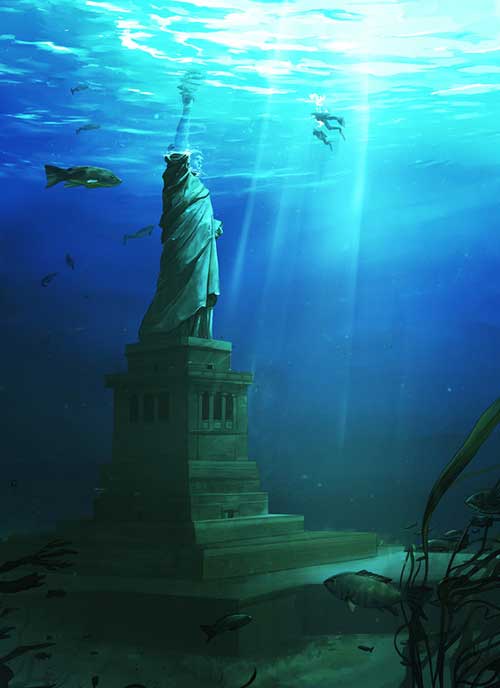
We had seen it before: the Piazza San Marco in Venice submerged by the acqua alta; New Orleans underwater in the aftermath of Katrina; the wreckage-strewn beaches of Indonesia left behind by the tsunami of 2004. We just hadn’t seen it here. (Last summer’s Hurricane Irene did a lot of damage on the East Coast, but New York City was spared the worst.) “Fear death by water,” T. S. Eliot intoned in “The Waste Land.” We do now.
There had been many warnings. In 2009, the New York City Panel on Climate Change issued a prophetic report. “In the coming decades, our coastal city will most likely face more rapidly rising sea levels and warmer temperatures, as well as potentially more droughts and floods, which will all have impacts on New York City’s critical infrastructure,” said William Solecki, a geographer at Hunter College and a member of the panel. But what good are warnings? Intelligence agents received advance word that terrorists were hoping to hijack commercial jets. Who listened? (Not George W. Bush.) If we can’t imagine our own deaths, as Freud insisted, how can we be expected to imagine the death of a city?
History is a series of random events organized in a seemingly sensible order. We experience it as chronology, with ourselves as the end point — not the end point, but as the culmination of events that leads to the very moment in which we happen to live. “Historical events might be unique, and given pattern by an end,” the critic Frank Kermode proposed in “The Sense of an Ending,” his classic work on literary narrative, “yet there are perpetuities which defy both the uniqueness and the end.” What he’s saying (I think) is that there is no pattern. Flux is all.
Last month’s “weather event” should have taught us that. Whether in 50 or 100 or 200 years, there’s a good chance that New York City will sink beneath the sea. But if there are no patterns, it means that nothing is inevitable either. History offers less dire scenarios: the city could move to another island, the way Torcello was moved to Venice, stone by stone, after the lagoon turned into a swamp and its citizens succumbed to a plague of malaria. The city managed to survive, if not where it had begun. Perhaps the day will come when skyscrapers rise out of downtown Scarsdale.
Humans are ingenious. Our species tends to see nature as something of a nuisance, a phenomenon to be outwitted. Consider efforts to save Venice: planners have hatched one scheme after another to prevent the city from sinking. Industrial development has been curtailed. Buildings dating from the Renaissance have been “relocated.”
The most ambitious project, begun a decade ago, is the installation of mobile gates in the lagoons. Known by the acronym MOSE — the Italian name for Moses, who mythically parted the Red Sea — it’s an intricate engineering feat: whenever the tide rises, metal barriers that lie in concrete bunkers on the sea floor are lifted by compressed air pressure and pivoted into place on hinges.
Is the Modulo Sperimentale Elettromeccanico — the project’s official name — some engineer’s fantasy? It was scheduled for completion this year, but that has been put off until 2014. Even if, by some miracle, the gates materialize, they will be only a stay against the inevitable. Look at the unfortunate Easter Islanders, who left behind as evidence of their existence a mountainside of huge blank-faced busts, or the Polynesians of Pitcairn Island, who didn’t leave behind much more than a few burial sites and a bunch of stone tools. Every civilization must go.
Yet each goes in its own way. In “Collapse,” Jared Diamond showed how the disappearance of a civilization has multiple causes. A cascade of events with unforeseen consequences invariably brings it to a close. The Norse of Greenland cut down their trees (for firewood and other purposes) until there were no more trees, which made it a challenge to build houses or boats. There were other causes, too: violent clashes with the Inuit, bad weather, ice pileups in the fjords blocking trade routes. But deforestation was the prime factor. By the end, no tree fell in the forest, as there was none; and there would have been no one to hear it if it had.
“Some say the world will end in fire, / Some say in ice,” declared Robert Frost. Another alternative would be lava. Pliny the Younger’s letters to Tacitus described the eruption of Mount Vesuvius: A plume of dirt and ash rose in the sky; rocks pelted Pompeii; and then darkness arrived. “It was not like a moonless or cloudy night, but like being in an enclosed place where the light has been doused.” Who did this? It must have been the gods. “Many were raising their hands to implore the gods, but more took the view that no gods now existed anywhere, and that this was an eternal and final darkness hanging over the world.” But of course it wasn’t the end of the world: it was just the end of them.
Contemplating our ephemerality can be a profound experience. To wander the once magnificent Roman cities strung along the Lycian coast of Turkey — now largely reduced to rubble, much still unexcavated — is to realize how extensive, how magisterial this civilization was. Whole cities are underwater; you can snorkel over them and read inscriptions carved into ancient monoliths. Ephesus, pop. 300,000 in the second century A.D., is a vast necropolis. The amphitheater that accommodated nearly 25,000 people sits empty. The Temple of Artemis, said to have been four times larger than the Parthenon, is a handful of slender columns.
YET we return home from our travels intoxicated by beauty, not truth. It doesn’t occur to us that we, too, will one day be described in a guidebook (Fodor’s North America 2212?) as metropolitans who resided in 60-story towers and traveled beneath the waves in metal-sheathed trains.
It’s this willed ignorance, I suspect, that explains why it’s difficult to process the implications of climate change for New York, even in the face of explicit warnings from politicians, not the most future-oriented people. Governor Andrew M. Cuomo has been courageous to make global warming a subject of public debate, but will taxpayers support his proposal to build a levee in New York Harbor? Wouldn’t it be easier to think of Sandy as a “once in a lifetime” storm? Even as Lower Manhattan continues to bail itself out — this time in the literal sense — One World Trade Center rises, floor by floor. The governor notes that “we have a 100-year flood every two years now,” which doesn’t stop rents from going up in Battery Park City.
Walking on New York’s Upper East Side, I was reminded by the gargantuan white box atop a busy construction site that the Second Avenue line, first proposed in 1929, remains very much in the works. And why not? Should images of water pouring into the subway tunnels that occupied our newspapers a few weeks back be sufficient to stay us from progress? “I must live till I die,” says the hero of a Joseph Conrad novel. The same could be said of cities.
When, on my way home at night, I climb the steps from the subway by the American Museum of Natural History — itself a monument to transience, with its dinosaurs and its mammoth and its skeleton of a dodo bird, that doomed species whose name has become an idiom for extinction — I feel more keenly than ever the miraculousness, the improbability of New York.
Looking down Central Park West, I’m thrilled by the necklace of green-and-red traffic lights extending toward Columbus Circle and the glittering tower of One57, that vertical paradise for billionaires. And as I walk past the splashing fountain in front of the museum’s south entrance on West 77th Street, I recall a sentence from Edward Gibbon’s ode to evanescence, “The Decline and Fall of the Roman Empire,” in which “the learned Poggius” gazes down at the remains of the city from the Capitoline hill: “The public and private edifices, that were founded for eternity, lie prostrate, naked, and broken, like the limbs of a mighty giant; and the ruin is the more visible, from the stupendous relics that have survived the injuries of time and fortune.”
This is our fate. All the more reason to appreciate what we have while we have it.
James Atlas is a contributing opinion writer and the author of a forthcoming book about biography.
- You are here:
-
Home

- News